
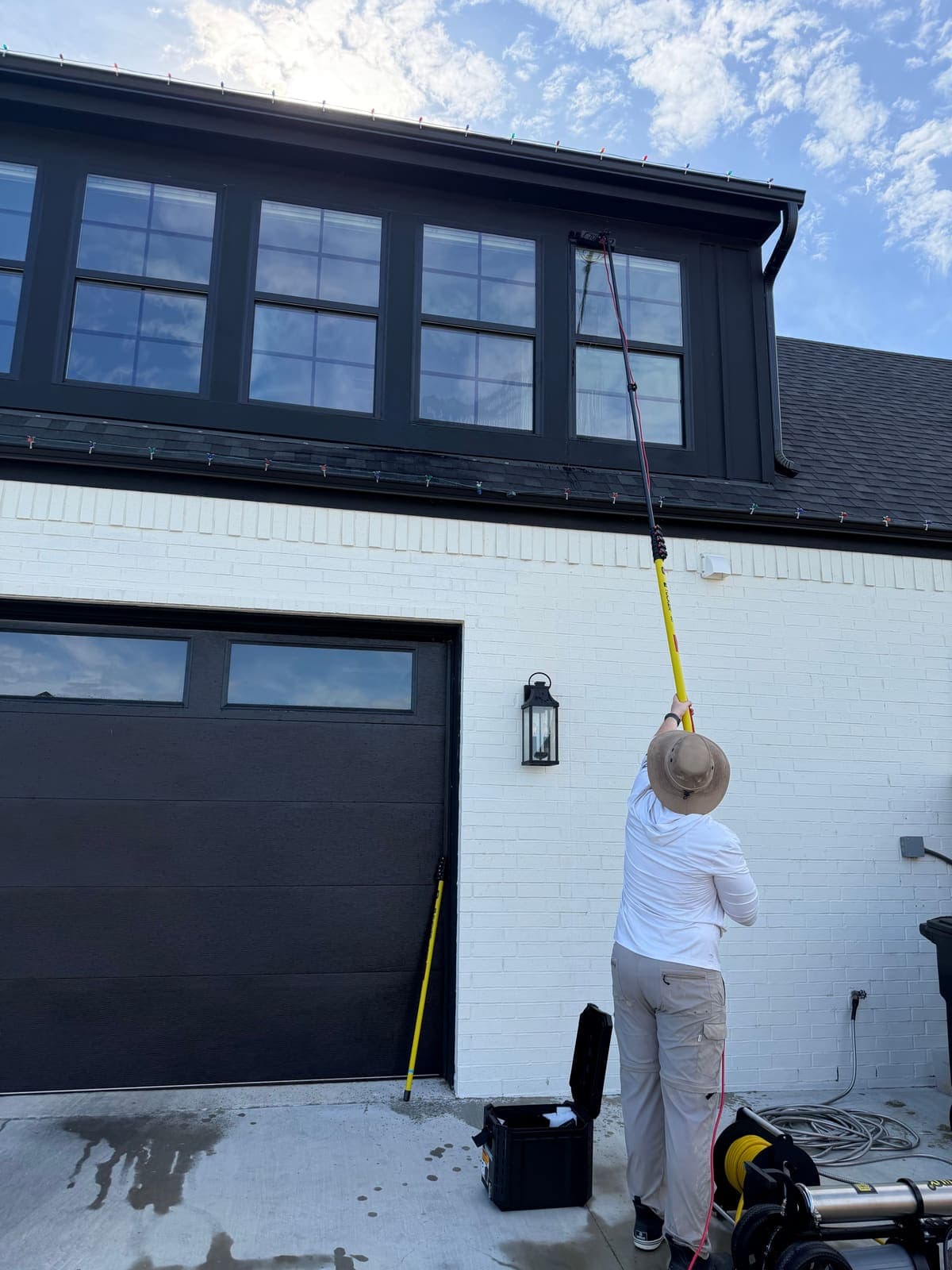
Window cleaning methods
Water-Fed Pole vs. Traditional Window Cleaning: Which Is Better for Your Home?
Get My Free QuoteThe short answer
If you've ever watched a professional window cleaner work, you've probably seen two different approaches: traditional squeegee cleaning and newer water-fed pole systems that wash windows with purified water. Both can produce excellent results, but they work differently and have distinct advantages.
Water-fed pole cleaning is often the better choice for routine exterior windows, particularly on two-story homes, while traditional squeegee cleaning remains an excellent choice for interior glass and detailed cleaning.
For homeowners in Waco, TX, understanding these differences can help you choose the right service for your home. At Centex Softwash, we use professional purified-water equipment to clean suitable exterior windows throughout Central Texas. Here's how the two methods compare.
What is water-fed pole window cleaning?
Water-fed pole window cleaning is a professional method that combines filtered water, a telescoping pole, and a specialized soft-bristle brush. Unlike traditional cleaning, which typically uses a detergent and squeegee, the water-fed pole system relies on purified water to rinse away loosened dirt.
A water-fed pole system usually has four main components:
- Water purification system: Filters ordinary water to remove dissolved minerals that could leave spots on the glass.
- Telescoping pole: Allows the technician to reach many elevated windows while standing on the ground.
- Soft-bristle brush: Loosens dirt, pollen, and other surface contaminants.
- Pure-water rinse: Flushes debris from the window and allows the glass to air-dry.
Water purification commonly uses reverse osmosis, deionization, or a combination of the two. The result is a cleaning process that can remove ordinary exterior buildup without needing a traditional squeegee for every pane.
What is traditional window cleaning?
Traditional window cleaning is the familiar process of applying cleaning solution to glass, scrubbing the surface, and removing the liquid with a rubber-bladed squeegee. Technicians typically use several tools, including:
- A cleaning solution and applicator
- A professional squeegee
- Microfiber or detailing cloths
- Extension poles or other access equipment
- Specialized tools for appropriate glass surfaces
The major advantage of this method is direct control. A trained technician can inspect the glass up close, clean around edges, and immediately remove water before it dries.
Traditional window cleaning is especially useful for interior windows, decorative glass, and surfaces requiring detailed hand cleaning. It's a proven method that still plays an important role in professional window cleaning.
Water-fed pole vs. traditional window cleaning: side-by-side comparison
Best application
- Water-fed pole
- Exterior windows
- Traditional squeegee
- Interior and detail work
Cleaning process
- Water-fed pole
- Purified water and brush
- Traditional squeegee
- Cleaning solution and squeegee
Elevated access
- Water-fed pole
- Many windows reached from the ground
- Traditional squeegee
- May need poles, ladders, or lifts
Drying
- Water-fed pole
- Glass air-dries
- Traditional squeegee
- Water removed immediately
Frames
- Water-fed pole
- Can be washed during the same process
- Traditional squeegee
- Usually detailed separately
Detergent
- Water-fed pole
- Often unnecessary for routine cleaning
- Traditional squeegee
- Generally used
Heavy buildup
- Water-fed pole
- May need additional treatment
- Traditional squeegee
- Allows targeted hand detailing
Finished results
- Water-fed pole
- Excellent when properly rinsed
- Traditional squeegee
- Excellent when properly detailed
Neither method guarantees a better result on every type of window. The quality of the cleaning depends on the glass, the condition of the window, the equipment, and the technician's technique.
5 advantages of water-fed pole window cleaning
1. Many second-story windows can be cleaned from the ground
One of the biggest advantages of water-fed pole technology is the ability to clean elevated exterior windows without routinely climbing ladders. Professional telescoping poles can reach many second-story and some higher windows, depending on the equipment and building layout.
This is especially useful for Central Texas homes with windows above garages, tall entryways, and difficult-to-access exterior walls.

Ground-based cleaning reduces certain ladder-related fall risks, although operators must still account for overhead power lines, uneven ground, weather, and other hazards. OSHA and the International Window Cleaning Association publish safety resources specifically addressing water-fed pole systems.
2. Purified water helps prevent mineral spots
Ordinary tap water contains dissolved minerals. When it evaporates, these minerals can remain on the glass as visible spots or residue. A professional water purification system removes most of those dissolved minerals before the water reaches the window.
After the technician scrubs and thoroughly rinses the glass, the purified water can be left to evaporate naturally. This is why water-fed pole cleaning does not usually require a final squeegee pass.
However, the finish still depends on effective brushing, proper rinsing, and adequate water purification. Dirty water running from the frames or contaminants left on the glass can still cause spots.
3. Frames can be cleaned along with the glass
Exterior windows accumulate more than dust on the glass itself. Pollen, cobwebs, and debris also settle on window frames and surrounding edges. A water-fed pole brush can clean the frames as part of the same washing process, provided the materials and window condition are suitable.
This is beneficial because dirty frames can release debris onto freshly cleaned glass when rainwater runs over them. Traditional cleaning can also address frames, but the technician may need separate tools and detailing steps.
4. Routine exterior cleaning may be more efficient
For homes with numerous exterior windows, water-fed poles can make the cleaning process more efficient. Technicians may be able to move between windows without repeatedly repositioning ladders or manually drying each pane. The difference can be especially noticeable on homes with large exterior glass surfaces.
That doesn't mean water-fed pole cleaning is always faster. Small divided panes, heavily soiled glass, and difficult access can change which method is more efficient.
5. Many windows can be cleaned without detergents
Routine purified-water cleaning often doesn't require soap or glass-cleaning chemicals. The brush provides physical agitation while purified water removes loosened dirt. This can be helpful for homeowners who prefer a detergent-free approach to routine exterior window maintenance.
Specialized cleaning products may still be necessary for stubborn stains, adhesive residue, or other unusual deposits.
When is traditional window cleaning better?
Despite the benefits of water-fed pole equipment, traditional window cleaning is still an excellent option in several situations.
Interior windows
Interior glass generally requires a more controlled cleaning method. A traditional applicator, squeegee, and microfiber cloth allow a technician to work around furniture, window treatments, and interior finishes without the continuous water flow used by an exterior pole system.
Small or decorative panes
Windows with numerous small panes, unusual shapes, or intricate details can be easier to clean by hand. Traditional methods give the technician precise control around individual edges and corners.
Stubborn residue
Paint overspray, adhesive, and certain construction contaminants may require specialized treatment. Routine purified-water cleaning cannot always remove these materials. Likewise, existing hard-water staining may require a separate removal procedure, regardless of the window cleaning method.
Special coatings and treated glass also require the correct manufacturer-approved cleaning techniques to avoid damage.
Windows requiring detailed inspection
Sometimes the best way to evaluate a problem is to inspect the glass closely. Hand cleaning can help a technician identify remaining residue, scratches, or other surface issues that need attention.
The important point: Professional window cleaning doesn't have to be one method or the other. The correct approach depends on the window and the job.
Does water-fed pole cleaning leave water spots?
This is one of the most common questions homeowners ask when they first see purified-water window cleaning. It can look unusual to watch a technician rinse a window and simply leave the water to dry.
But purified water behaves differently from ordinary tap water. Because most dissolved minerals have been removed, a properly cleaned and rinsed window can dry clear without being wiped.
That said, purified water isn't a guarantee against spotting. Remaining marks can result from:
- Dirt or detergent residue left on the glass
- Debris washing down from dirty frames
- Incomplete rinsing
- Problems with the water purification system
- Existing mineral staining that routine cleaning cannot remove
Glass that is very dirty or has not been professionally cleaned in years may require additional scrubbing, rinsing, or traditional detailing during its initial service.
Is water-fed pole cleaning safe for residential windows?
Water-fed pole cleaning is generally well suited to many standard residential exterior windows when the equipment is used correctly.
Unlike pressure washing, water-fed pole cleaning relies primarily on brushing and a controlled flow of water, not a high-pressure jet. That distinction is important: high-pressure washing can damage window seals, force water into openings, or harm certain surfaces when used improperly. Water-fed pole cleaning is designed for a different purpose.
However, damaged seals, deteriorating frames, specialty coatings, and fragile glass still require careful evaluation. No cleaning method is appropriate for every window without considering its condition. Professional operators also need to assess electrical hazards and the work area before extending a pole.
Which method works best for Waco, Texas homes?
For many homes in Waco, Woodway, Hewitt, Robinson, and China Spring, purified-water window cleaning is a practical option for regular exterior maintenance. Central Texas presents several common challenges for keeping glass clean.
Seasonal oak and cedar pollen
Pollen can settle on windows, screens, and frames, leaving a dusty film. A water-fed pole brush can loosen this buildup while purified water rinses it away.
Windblown dust
Homes near open land, busy roads, and active construction areas may accumulate dust on exterior glass. Routine exterior cleaning can help restore clearer windows before layers of debris become more difficult to remove.
Sprinkler overspray
Irrigation systems that repeatedly spray windows can create hard-water deposits. While purified water helps avoid adding new mineral residue during cleaning, it doesn't automatically remove existing hard-water stains. Those deposits may need additional treatment.
Two-story homes
Homes with elevated bedroom windows, tall foyers, or glass above garages can benefit from water-fed pole access when conditions allow. For these properties, a combination of purified-water exterior cleaning and traditional interior detailing may be the most practical solution.
Learn more about our exterior cleaning services in Waco, TX.
Is water-fed pole window cleaning more expensive?
Not necessarily. Professional window cleaning costs generally depend more on the size and complexity of the job than on which cleaning method is used. Factors that affect the estimate include:
- Number and size of windows
- One-story or multi-story access
- Interior-only, exterior-only, or both sides
- Amount of dirt or mineral buildup
- Screens, tracks, and additional detailing
- Frequency of cleaning
Water-fed pole systems require specialized equipment and water filtration, but they may also reduce labor time on suitable exterior windows. Those factors don't translate into a universal price difference.
At Centex Softwash, window cleaning starts at $129 for qualifying small-home exterior projects, with final pricing based on your property and requested services. For a full breakdown, see our Waco window cleaning cost guide, or request a free window cleaning estimate to get an accurate price.
Should you choose water-fed pole or traditional window cleaning?
The best choice depends on what you're having cleaned.
Choose water-fed pole cleaning when:
- You want routine exterior window cleaning.
- Your home has elevated or difficult-to-reach exterior glass.
- You're dealing with normal pollen and dust buildup.
- You want a purified-water cleaning process.
- You have a large number of suitable exterior windows.
Choose traditional window cleaning when:
- You need interior glass cleaned.
- Your windows have intricate or decorative panes.
- Detailed hand cleaning is necessary.
- You're dealing with stubborn residue that requires a specialized approach.
For a full-home cleaning, the ideal solution may include both methods. A reputable window cleaning company should evaluate your property and recommend the appropriate technique rather than insisting that one process works for every window.
Free estimate
Professional window cleaning in Waco, TX
At Centex Softwash, we believe the equipment should fit the job, not the other way around. Our professional purified-water, water-fed pole system helps us clean suitable exterior windows throughout Central Texas, including many elevated windows that would otherwise be difficult to access.
Whether you're preparing your home for sale, cleaning up after pollen season, or adding window cleaning to your regular property maintenance, we're here to help. We serve homeowners and businesses throughout Waco, Woodway, Hewitt, Robinson, China Spring, Temple, and surrounding Central Texas communities.
Exterior window cleaning starts at $129 for qualifying small homes. Centex Softwash has been serving Central Texas since 2018.
FAQ
Frequently asked questions
Is water-fed pole window cleaning better than traditional cleaning?
Water-fed pole cleaning is often more practical for routine exterior windows, especially those above ground level. Traditional squeegee cleaning offers greater control for interiors and detailed work. Both can provide excellent results when performed correctly.
Why don't window cleaners dry the windows after using a water-fed pole?
Purified water contains very little dissolved mineral content. After proper brushing and rinsing, it can evaporate without leaving the mineral spots associated with ordinary tap water.
Can water-fed pole cleaning remove hard-water stains?
It can remove everyday dirt and prevent the cleaning water from adding new mineral deposits. However, stubborn existing hard-water stains often require a separate treatment, and permanent glass etching cannot be removed through routine cleaning.
Do water-fed poles scratch windows?
Properly selected, clean, nonabrasive brushes are designed for window cleaning. However, trapped grit, incorrect tools, or unsuitable glass surfaces can create scratch risks. Professionals should inspect the window condition and use appropriate techniques.
Can a water-fed pole clean window screens?
Water-fed pole systems are primarily designed to clean exterior glass and compatible surrounding surfaces. Screens may need to be removed or cleaned separately for a thorough result. Confirm screen-cleaning arrangements when booking.
Does water-fed pole cleaning keep windows clean longer?
There isn't a universal guarantee that one method keeps windows clean longer. Purified water can avoid leaving detergent and mineral residue during cleaning, but pollen, dust, rain runoff, and other environmental conditions determine how quickly windows become dirty again.
How often should windows be professionally cleaned in Waco?
For many homeowners, once or twice per year is a reasonable starting point. Properties near trees, construction, busy roads, or irrigation overspray may benefit from more frequent exterior cleaning.